DEC-MAPF




DEC-MAPF is a Python simulation and experimentation framework for Decentralized Multi-Agent Path Finding. Study how agents coordinate, compare decentralized methods with centralized solvers, and develop your own approaches using shared scenarios, execution, validation and analysis tools. Run studies from Python or the CLI, then inspect trajectories and recorded decisions in the optional visual workspace.
The framework separates experiment infrastructure from solver implementations. Its current decentralized methods use token-based negotiation, including HeatMap and PathAware; centralized methods include CBS and Prioritized Planning, with optional native EECBS/CBSH2-RTC adapters. The extension guide explains how additional solvers and coordination protocols can use the same experiment workflow.
Alpha software for research and experimentation. Run complete studies from Python or the CLI, and use the optional GUI to inspect individual decisions. Read alpha status and scientific scope before interpreting results.
Get started · Gallery: article settings · Researcher guide · Experiment protocol · Cite
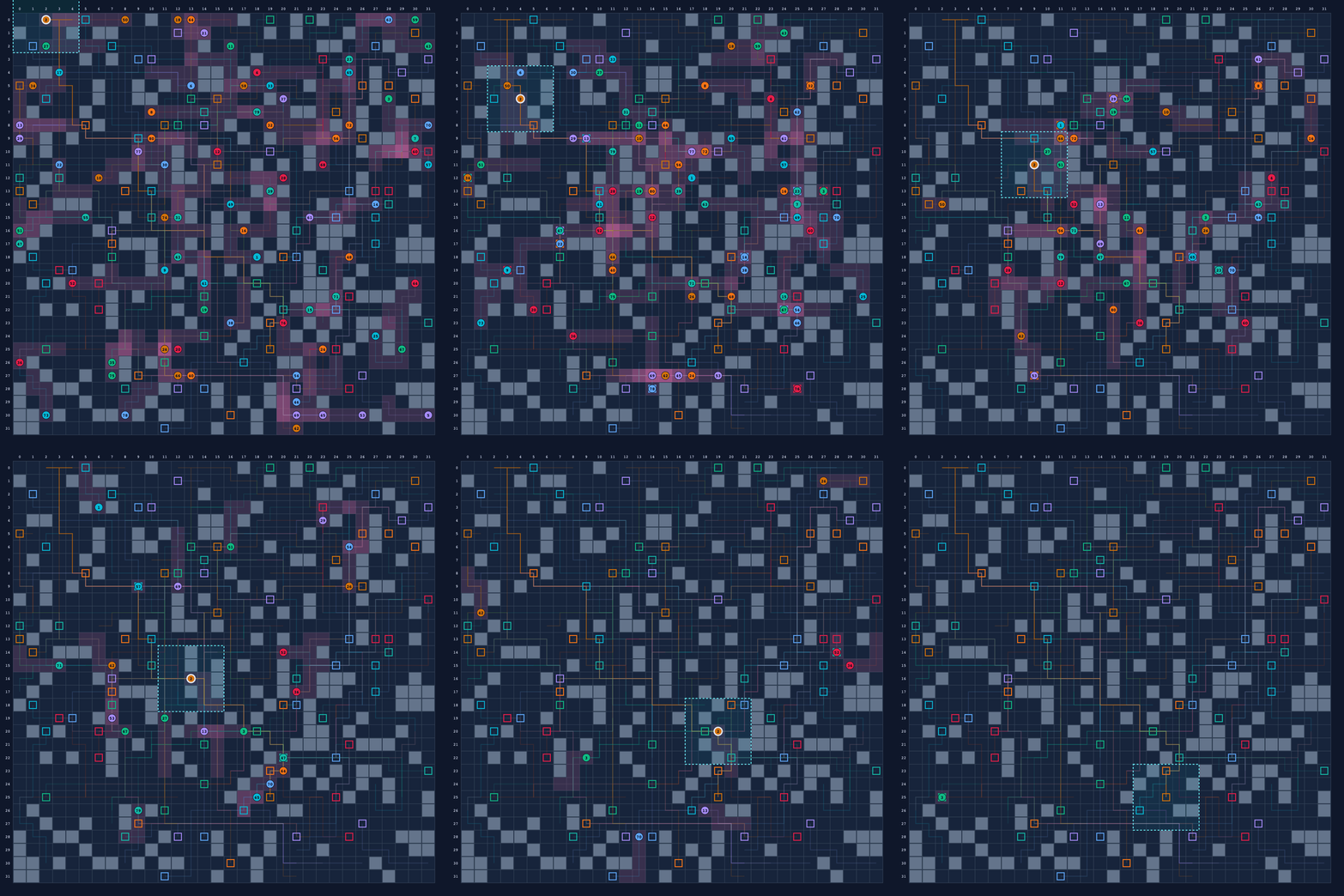
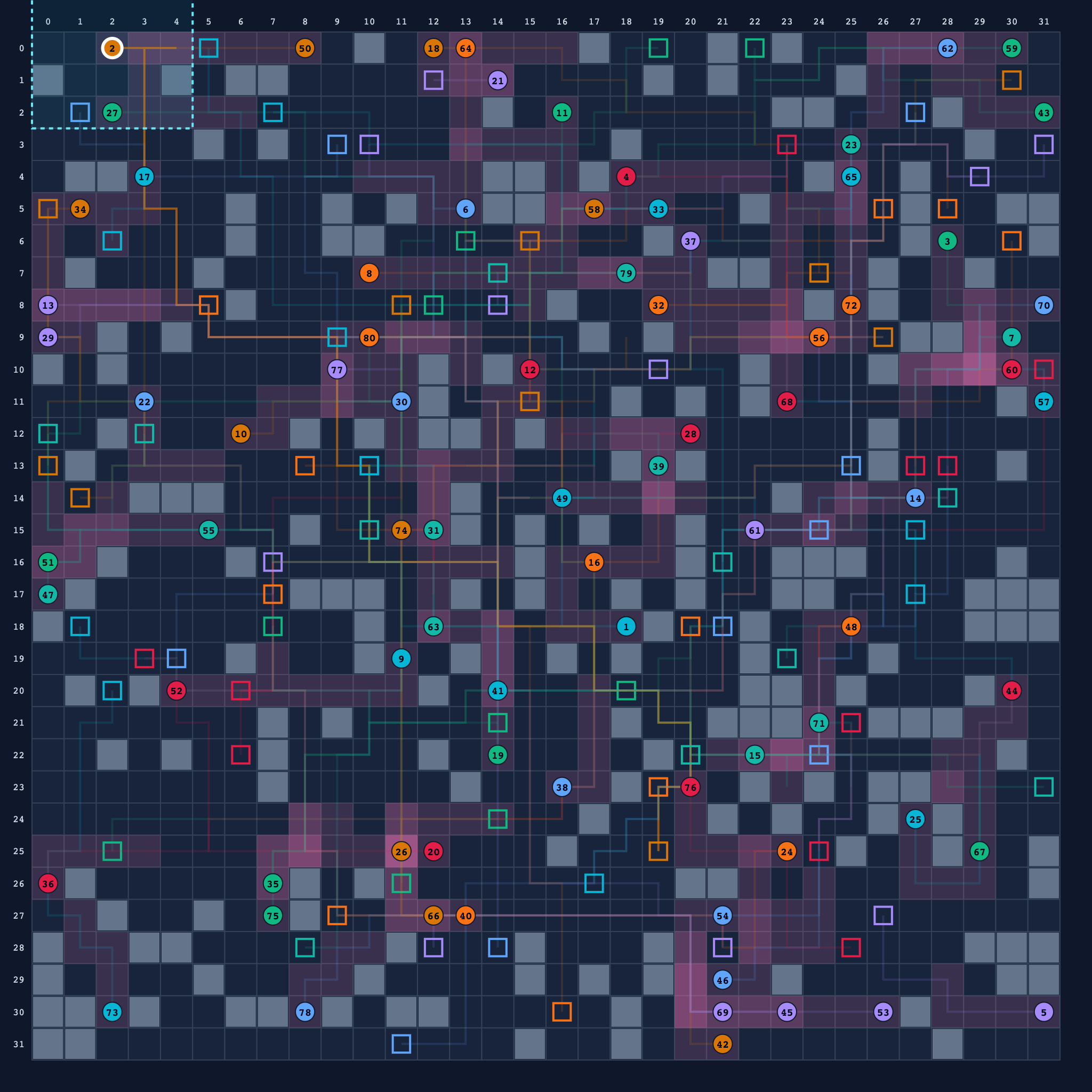
Follow one agent through the negotiation. 32×32 · 80 agents · approximately 20% obstacles · HeatMap · zero commitment · FoV 5. Agent 2 reaches its goal in 47 actions, participates in five negotiations, and revises its remaining plan on five recorded steps. The full replay runs from t=0 to t=50; all 80 agents reach their goals.
The white ring selects agent 2; cyan marks its FoV geometry. Paths and pink heat show executed history and hindsight, not the agent's complete knowledge. This selected, independently valid modern execution illustrates the method, rather than estimating its success rate. Full-resolution animation · Still image · Replay evidence and layer guide.
Choose your path: compare methods from the CLI, inspect a simulation in the GUI, or develop a solver or coordination protocol.
Software checks: Core qualification · GUI and packages. Open the exact commit's results; these checks qualify software workflows, independently of article-reproduction scores.
Explore the system
| Build an experiment | Understand a decision | Preserve the evidence |
|---|---|---|
| Explicit scenarios, four physical settings, decentralized and centralized solver matrices | Replay from t=0; select an agent; inspect trajectories and the diagnostics recorded by its method | Immutable inputs, bounded processes, independent trajectory checks, attempt history and portable exports |
| Run entirely from Python or the CLI; add methods through the solver contract | For negotiation methods, inspect local views, offers, decision heat and commitments | Export every planned outcome; compare costs on common valid solved instances |
A shared workflow for different methods
| Research task | Starting point |
|---|---|
| Study decentralized coordination | Run the included HeatMap and PathAware methods; inspect local observations and interactions |
| Compare against centralized planning | Run CBS or Prioritized Planning on the same scenarios, settings and declared budgets; configure native baselines when needed |
| Add another method | Implement MAPFSolverProtocol, register an importable factory and validate its trajectories through the extension workflow |
Auction-based coordination and other decentralized protocols can be developed as additional solver implementations. Their coordination rules and method-specific inputs or telemetry need their own implementation and validation; the scenario, batch, result and analysis infrastructure can be reused. See a new coordination protocol for the integration boundaries.
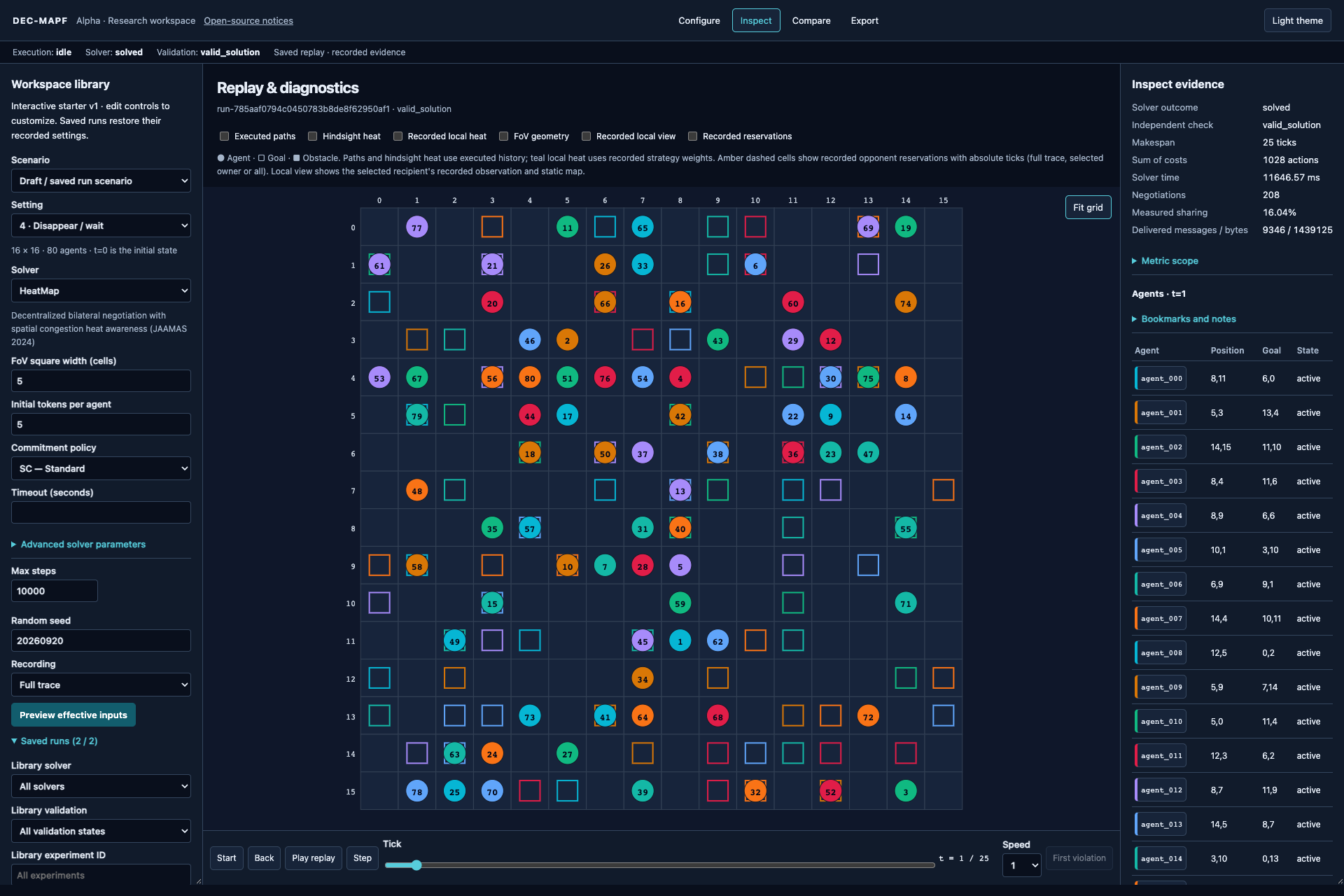 Negotiate in dense shared space. 16×16, 80 agents, 31.25% initial occupancy. |
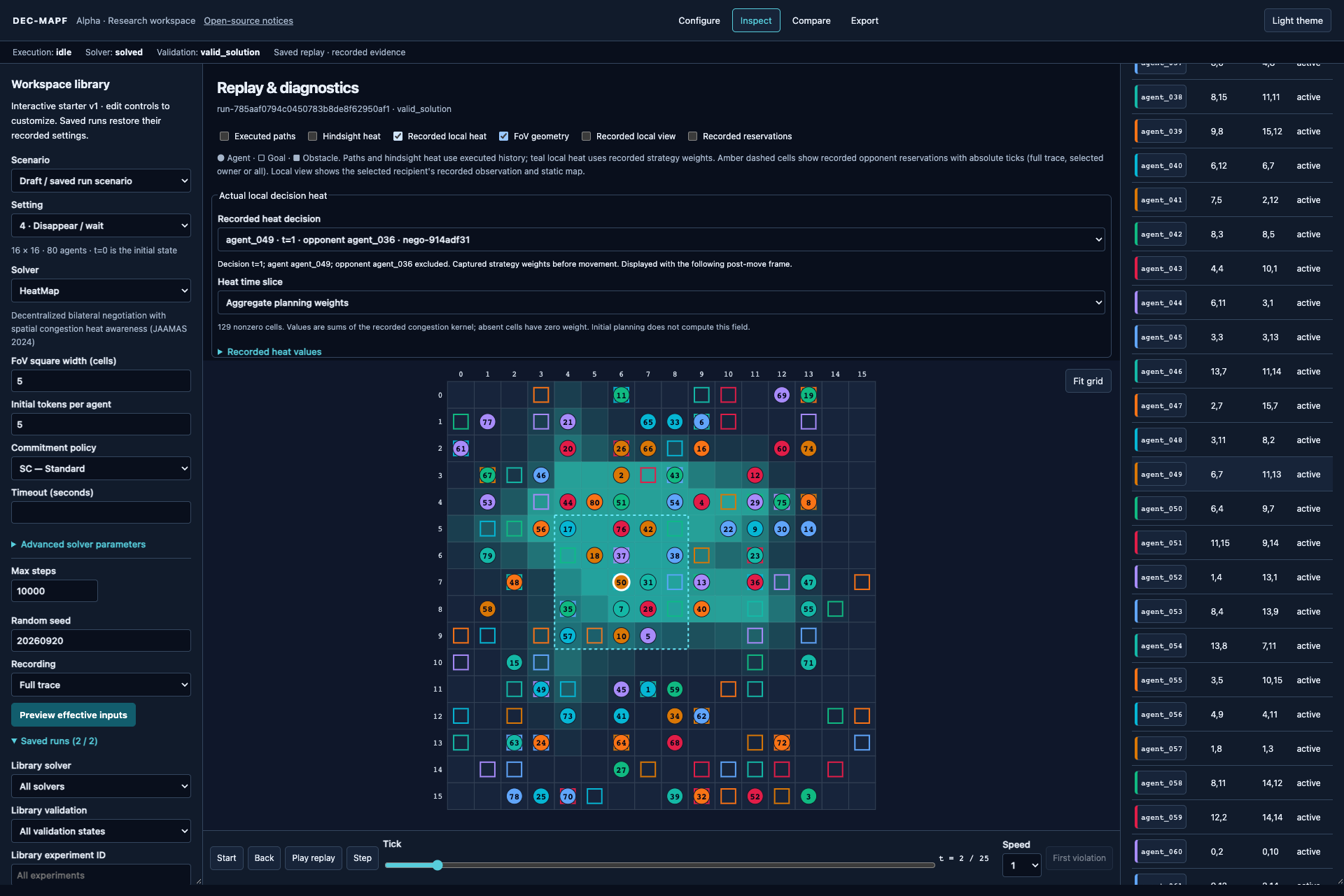 Explain a local decision. Recorded strategy weights and FoV. |
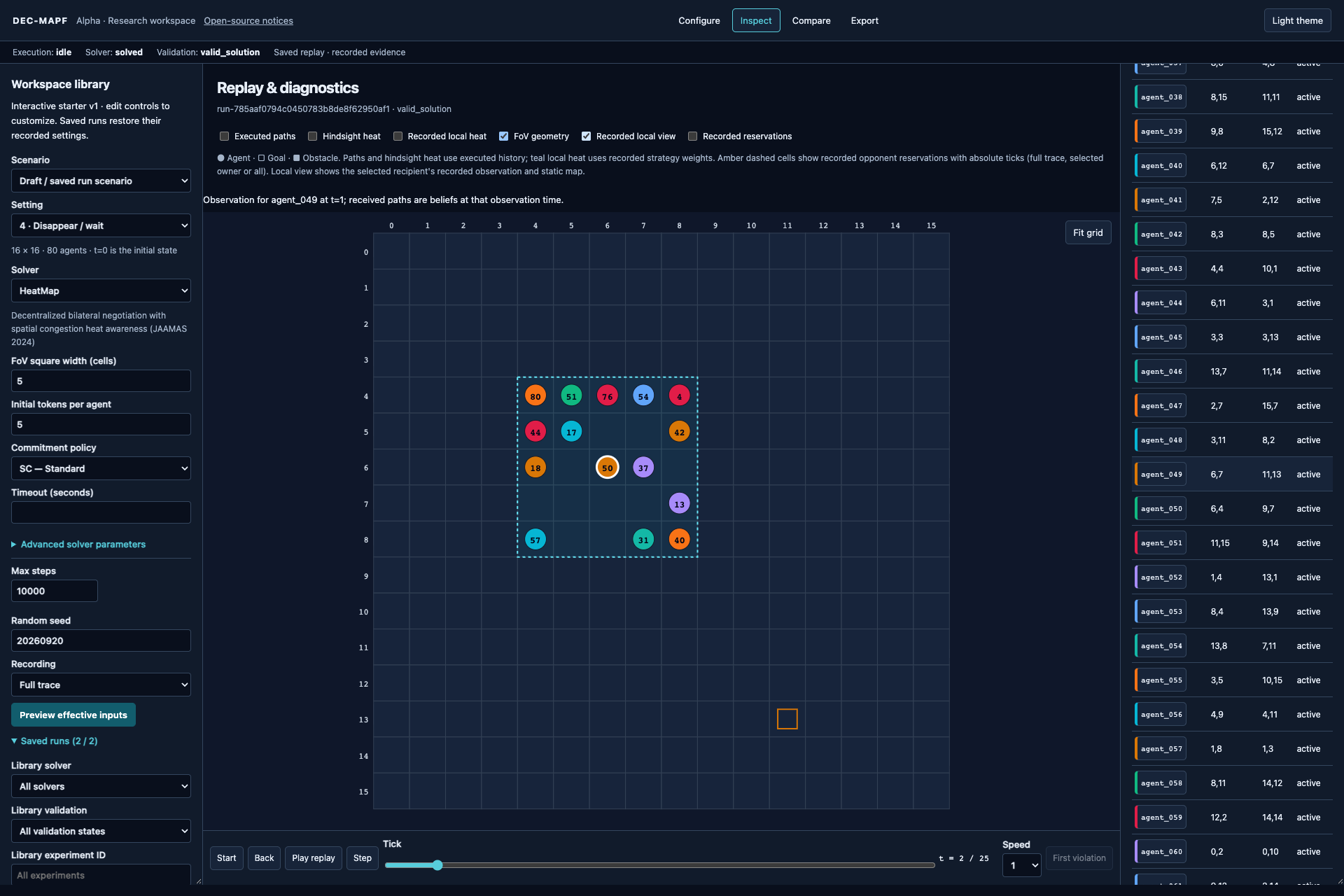 Separate knowledge from hindsight. Recipient-local evidence. |
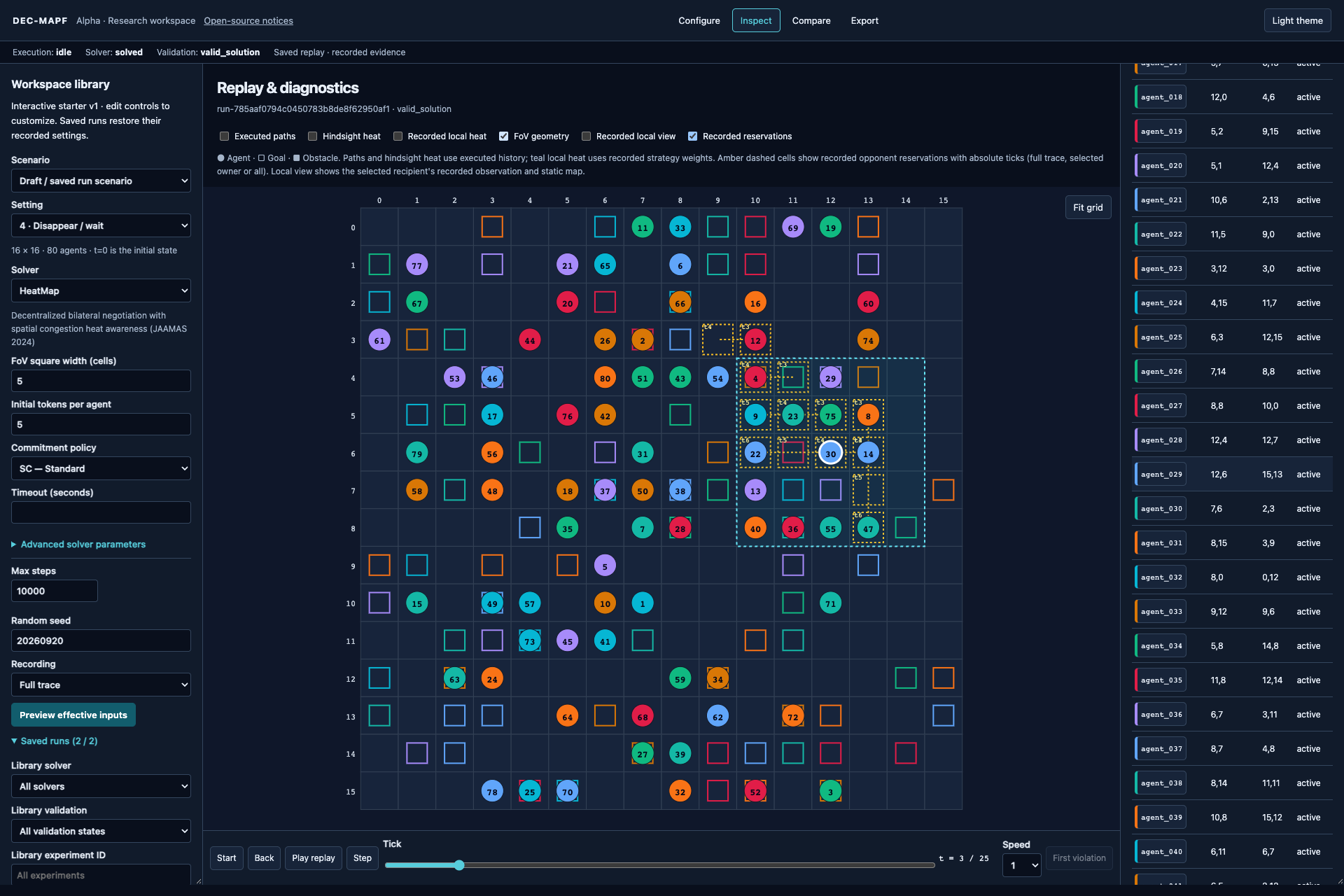 Inspect what an agreement protects. Commitments with absolute ticks. |
Open the full gallery for configurations, density definitions, selection rules and replay provenance. These examples show the included negotiation methods in dense shared space and constrained routing. They use the modern implementation and inputs matching the article settings; full-trace recordings preserved the original paths and scientific metrics exactly.
Get started
Clone the repository, then choose a workflow. Commands below run from the repository root in a POSIX shell. Installation covers environments, Windows, packaged installs and native solver options.
git clone https://github.com/monurkeskin/DEC-MAPF.git
cd DEC-MAPF
Headless: your first eight-trial MAPF study
Python is sufficient. This tutorial runs HeatMap, PathAware, CBS and Prioritized Planning on the same two small fixtures: eight trials spanning decentralized and centralized methods, saved for analysis and optional GUI inspection.
uv sync --locked --python 3.12
uv run --no-sync mapf doctor
mkdir -p runs/tutorial
uv run --no-sync mapf batch plan examples/method-comparison.json --output runs/tutorial/manifest.json
uv run --no-sync mapf batch run runs/tutorial/manifest.json --workspace runs/tutorial/workspace
uv run --no-sync mapf batch status --workspace runs/tutorial/workspace
The result reports planned, successful and execution counts. Inspect the saved validation status as well as whether execution finished. Use a fresh directory for a new study, or the explicit resume workflow for an existing one.
The GUI's initial inputs are the named interactive-v1 preset. Python, HTTP and batch specifications can select that same preset explicitly. It is a small interactive starting point, not a paper configuration; shared presets explain overrides and identities.
Continue with headless experiments: build your own matrix, interrupt/resume, export all outcomes, and generate paired analyses and figures. The 16-case smoke example covers all four physical settings with CBS and Prioritized Planning.
GUI: run, inspect, replay, export
Install the GUI extra and build the frontend once. Node is used to build the source checkout's UI; it is not needed for headless Python execution.
uv sync --locked --python 3.12 --extra gui --extra analysis
npm --prefix frontend ci
npm --prefix frontend run build
uv run --no-sync mapf dashboard --host 127.0.0.1 --port 8000
Open http://127.0.0.1:8000. Choose a scenario, physical setting and solver, inspect Preview effective inputs, then Run simulation. Use HeatMap to explore local negotiation or CBS for a centralized example. Check Independent check, replay with Step, select an agent and inspect its evidence. Compare aligns saved runs; Export provides a checked bundle, SVG, CSV, LaTeX and a standalone HTML replay.
Follow the illustrated GUI walkthrough for the complete sequence, custom scenarios, local heat, commitments, comparison and export. To inspect a completed headless study, serve that study's workspace after its CLI runner has exited:
MAPF_WORKSPACE_DIR=runs/tutorial/workspace uv run --no-sync mapf dashboard --host 127.0.0.1 --port 8000
Research semantics at a glance
| Setting | Wait before reaching the goal? | After first arrival |
|---|---|---|
| 1 | No | Remain at the goal |
| 2 | Yes | Remain at the goal |
| 3 | No | Disappear after the arrival tick |
| 4 | Yes | Disappear after the arrival tick |
t=0 is the initial state. Costs count actions until first goal arrival. Independent validation checks the roster, starts/goals, obstacles, bounds, adjacency, waits, vertex and reverse-edge collisions, and departure after arrival. A completed job is not necessarily a valid solution.
For the included negotiation methods, the default token protocol is taop-v2. Standard (SC), dynamic (DC) and zero (ZC) commitments have explicit temporal semantics, including protection during the agreement tick. Process deadlines, bilateral negotiation deadlines, simulation step guards and search limits are separate controls. See simulation and interpretation, parameters, protocol conformance and metric definitions.
HeatMap and PathAware are the principal decentralized strategies. Built-in CBS and Prioritized Planning support centralized comparisons. Optional qualified native EECBS/CBSH2-RTC profiles have a separate installation and licensing path. Legacy EECBS-* Python names denote SimplifiedFocalCBS and do not establish the published EECBS algorithm or a certified bound. See the solver guide.
This implementation is related to the JAAMAS 2024 and EUMAS 2021 papers below. Software checks and the gallery demonstrate current implementation behavior. Historical numerical reproduction requires matching instances, protocol, solver versions, budgets and analysis denominators; consult reproducibility before interpreting an article comparison.
Find the right guide
| Goal | Guide |
|---|---|
| Install with only the dependencies you need | Installation |
| Learn the GUI with actual screenshots | GUI walkthrough · Gallery |
| Run batches without a browser | Headless tutorial · Experiment reference |
| Admit mixed workloads within local CPU/RAM budgets | Optional resource admission |
| Bring your own map, roster or MovingAI files | Scenarios |
| Understand results, limits and fair comparisons | Scientific interpretation · Metrics |
| Script the system from Python or HTTP | Python and API guide |
| Diagnose a failure or missing layer | Troubleshooting |
| Add a solver or coordination protocol | Extension guide · Public API |
| Develop, test or distribute the framework | Architecture · Contributing |
| Navigate the repository or learn from related tools | Project map · Engineering references |
| Understand CI and package delivery | Distribution checks |
The full documentation index includes architecture, validation, provenance and method references. The Python framework is MIT licensed. See licenses and attribution for the bundled GUI/docs notices and the separate, restricted terms of optional native solvers.
Citations
If you use this simulation framework in your research, please cite the corresponding publication:
JAAMAS 2024
@article{keskin2024mapf,
  title     = {Decentralized multi-agent path finding framework and strategies based on automated negotiation},
  author    = {Keskin, M. Onur and Cant{\"u}rk, Furkan and Eran, Cihan and Aydo{\u{g}}an, Reyhan},
  journal   = {Autonomous Agents and Multi-Agent Systems},
  volume    = {38},
  number    = {1},
  pages     = {10},
  articleno = {10},
  year      = {2024},
  publisher = {Springer Nature},
  doi       = {10.1007/s10458-024-09639-8},
  url       = {https://doi.org/10.1007/s10458-024-09639-8}
}
EUMAS 2021 (Second Best Paper Award)
@inproceedings{eran2021token,
  title     = {A Decentralized Token-Based Negotiation Approach for Multi-Agent Path Finding},
  author    = {Eran, Cihan and Keskin, Mehmet Onur and Cant{\"u}rk, Furkan and Aydo{\u{g}}an, Reyhan},
  booktitle = {European Conference on Multi-Agent Systems (EUMAS 2021)},
  pages     = {264--280},
  doi       = {10.1007/978-3-030-82254-5_16},
  year      = {2021},
  publisher = {Springer},
  note      = {Winner of the Second Best Paper Award (Runner-up)}
}
Machine-readable citation metadata is available in CITATION.cff, codemeta.json, and .zenodo.json.
From a first replay to your own study
Follow one real negotiation, execute a small complete capsule, or run mapf study init my-study to create an editable headless project. The searchable local docs bring tutorials, task guides, references and scientific explanation together.
For research reuse, start with the public API, compatibility matrix and experiment workflow. Record the exact source commit, dependency lock and effective inputs so another researcher can repeat your study.