DEC-MAPF researcher documentation
Simulate decentralized MAPF, compare methods and develop your own. Read the version status and scientific scope, then choose a workflow below.
DEC-MAPF provides shared scenarios, physical settings, supervised solver execution, independently checked trajectories and a reproducible experiment journal for decentralized and centralized MAPF methods. You can use the entire workflow without opening a browser; the optional GUI adds visual inspection of the same saved runs. The included decentralized methods use negotiation. Additional methods enter through the solver and protocol extension boundaries.
Start here
| Your starting point | Follow this path | What you will have at the end |
|---|---|---|
| I want to see the system | Gallery → Installation → GUI walkthrough | A validated simulation, inspected decisions and a portable replay |
| I want to run an experiment | Installation → Headless tutorial → Reproducibility | A frozen matrix, all-outcome table and qualified paired analysis |
| I want to compare decentralized and centralized methods | Eight-trial example → Solver guide → Metrics | Matched scenarios, explicit budgets and independently validated outcomes |
| I want to add a solver or coordination protocol | Extension guide → Public API → Architecture | A clear adapter, configuration and telemetry integration path |
| I have my own maps and agents | Scenarios → Parameters → Solvers | Validated inputs with explicit identities and supported settings |
| I want to use Python or HTTP | Python and API → Contracts | A programmatic run using the same application services |
| I want to contribute | Contributing → Extending → Workspace architecture | A tested change with clear scientific and API consequences |
Understand what the evidence means
- Simulation and scientific interpretation: ticks, movement settings, negotiations, commitments, validation, costs and denominators.
- Metric definitions: measured communication, unavailable values, detours and qualified comparison quantities.
- Experiment reference: budget enforcement, attempt lineage, stopping reasons and source checks.
- Reproducibility: what to freeze, what to report, and how article-derived profiles differ.
- TAOP conformance and centralized conformance: exact implementation boundaries and comparison assumptions.
- Solver identities, algorithm semantics and native baselines: the algorithm behind each name.
- Citation provenance: stable publication metadata; citations are also in the README.
Reference and recovery
Use Troubleshooting for installation, missing replay layers, timeouts, source mismatches and pairing errors. The parameter reference is generated from the current request models. Live HTTP schemas are available at /docs and /openapi.json on your local server; the versioned OpenAPI file supports client generation.
The gallery provenance identifies the actual runs and image checksums. Documentation verification records the bounded checks performed for this guide. The examples index distinguishes runnable experiment specifications from direct Python API illustrations.
Maintainer and method references
Use the project map for repository contents and workflow ownership, related tools for the engineering references, and CI/distribution checks for package qualification and future release boundaries.
Read Architecture and extension boundaries for domain/service ownership and resource-aware batches for optional measured CPU/RAM admission in the ordinary CLI and GUI workflows.
The GUI contracts, integration policy, GUI development environment, Java mapping and design rationale describe current responsibilities, contracts and scientific interpretation. The benchmark guide distinguishes software regression fixtures from empirical studies.
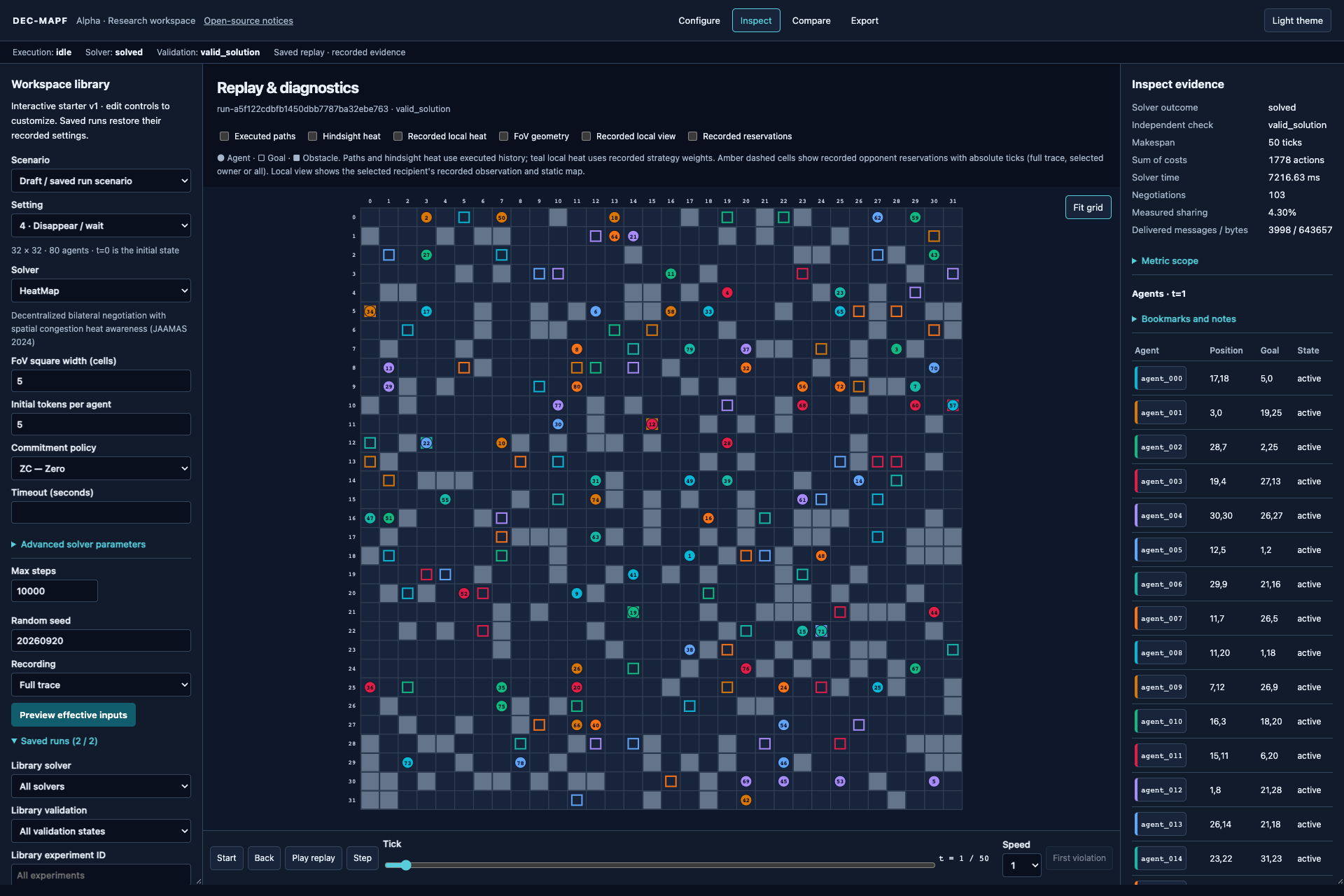
32×32 cells, 205 blocked cells (~20%), 80 agents, HeatMap with ZC and FoV 5. A selected valid modern solution from the article-verification population. Selection and provenance qualify what this example establishes.
New-study tools and searchable reading
Create a study, run a complete capsule, follow one recorded negotiation, or build the searchable local site. The public API, compatibility matrix, glossary and maintenance scope make the supported boundaries explicit.
Next: choose the workflow matching your question from the table above.